


A pre-peak forklift fleet readiness audit takes four weeks, and it catches three failure modes that surface exactly when you can’t afford them: an aged battery that dies mid-shift, a weak cell dragging down a full string, and a fleet that simply doesn’t have enough charged batteries to cover a second shift. Run it on a schedule. Week 1, pull every battery’s age and cycle count. Week 2, run a specific-gravity survey and load test. Week 3, inspect chargers and connectors. Week 4, do the shift math. Start now and you fix problems in September instead of discovering them in November.
What does a mid-peak battery failure actually cost?
One 24-hour connector failure runs about $2,600 all-in, according to a cost model from Anderson Power. That number isn’t abstract. It breaks down into parts you’ll recognize on your own P&L.
- $160 in idle labor while the truck sits
- $240 in overtime to make up the throughput
- $350 for emergency rental and delivery
- $650 in technician labor
- Roughly $1,200 in lost productivity
Now multiply by however many trucks are one worn connector away. McKinsey reports that 42% of downtime hours trace to equipment failure, and that predictive maintenance cuts downtime 30 to 50% while extending equipment life 20 to 40%. A battery audit is predictive maintenance you can run yourself. Most of it doesn’t require a vendor.
Week 1: How old is every battery in the fleet?
Pull the date code off every tray. Every one. You’re building a list of age and, where your chargers log it, cycle count.
Lead-acid service life runs roughly 1,500 cycles or three to five years. Anything past those marks is a peak-season risk, full stop. It may still run fine on a light day and still leave you stranded on a heavy one.
Flag those batteries now. You want the weakest units identified before you decide what Week 2’s testing prioritizes. If the list is long, you already have your answer about whether the fleet is a problem.
Why can a battery show green on the charger and still fail?
Because the charger reports voltage, not health. A battery can accept a full charge and still hold a dead or reversed cell that collapses under load. This is the failure mode that surprises people, and it’s the one covered in How to Know When Your Forklift Battery Is Lying to You.
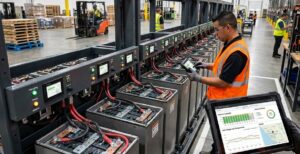
Week 2 is a hydrometer survey. You read specific gravity cell by cell across each string. A single weak cell drags down the entire string, so what you’re hunting for is spread: the gap between your strongest and weakest cells.
Here’s the honest limit. You can take specific-gravity readings yourself, and you should. But a proper load test, run under the current the truck actually draws, is what confirms a string will hold up across a full shift. That test needs a technician and the right equipment. Our on-site battery maintenance and repair team performs it, and so do others. The point is to get it done, not to guess.
Are your chargers and connectors ready for the run rate?
Week 3 moves to the equipment feeding the batteries. Walk every charging station.
- Inspect connectors for pitting, heat discoloration and loose retention. A worn connector is the single cheapest failure to prevent and the $2,600 one to ignore.
- Check cables for cracked insulation and exposed strands at the strain relief.
- Retire timer-based chargers that keep pushing current after the battery is full. Overcharging cooks water out of the cells and shortens life.
One rule governs charger-to-battery fit: the charger must match the battery voltage and sit within 10% of the battery’s amp-hour rating. Undersized, it never finishes; oversized, it overheats the plates. Verify the pairing at every station, because fleets drift out of spec as batteries get swapped around.
How many forklift batteries do I need per truck?
Week 4 is arithmetic, and it decides whether the first three weeks even matter. The governing concept is the 8-8-8 rule for flooded lead-acid: eight hours of run time, eight hours to charge, eight hours to cool. One battery per truck, one shift a day, and the math works.
Add a second shift and the rule breaks. There aren’t enough hours left to charge and cool before the battery is needed again. When that happens, you have three options:
- A second battery per truck, so one runs while the other charges and cools. Cheapest per truck, but you need the change-out equipment and the floor space.
- TPPL batteries, which tolerate opportunity charging during breaks and can carry a second shift on a single tray. Higher upfront cost, less handling.
- Fast or opportunity charging on your existing chemistry, if the batteries and chargers are rated for it. Verify before you assume.
We sell every one of these, which is exactly why we’ll tell you which your duty cycle actually justifies. If you run a single shift at moderate volume, a second battery per truck may be money you don’t need to spend. If you’re running two hard shifts through peak, opportunity charging or TPPL may be the only options that hold. The right answer is the one that matches how you actually run, not what any dealer is trying to move. For the ongoing side of this, Forklift Battery Maintenance: Protect Your Fleet and Your Bottom Line covers the routine that keeps the math working all season.
What if Week 1 already looks bad?
If the age list is long and peak is close, you bridge the gap rather than gamble on it. Battery rental and leasing covers you while you sort out permanent replacements, and reconditioned batteries can fill in at lower cost than new. Move early: the Material Handling Wholesaler Q2 2026 dealer survey reports that manufacturer lead times remain extended and rental activity has strengthened significantly. The units get harder to source the closer you get to peak.
Ready to find out where your fleet stands?
Book a pre-peak battery health assessment and we’ll run the load test and specific-gravity survey on-site, across Maryland, Northern Virginia, Delaware and South-Central Pennsylvania. Start Week 1 yourself today, and bring us in for the tests only a technician can confirm.
Beal Industrial Products
7513 Connelley Dr, Hanover, MD 21076
(410) 768-6200
Contact Beal Industrial Products
Frequently Asked Questions
How many forklift batteries do I need per truck?
For a single shift, one battery per truck works under the 8-8-8 rule: eight hours of run time, eight to charge, eight to cool. A second shift breaks that math because there aren't enough hours left to charge and cool before the battery is needed again. When that happens, your options are a second battery per truck with change-out equipment, TPPL batteries that tolerate opportunity charging, or fast/opportunity charging on your existing chemistry if the batteries and chargers are rated for it.
Can a forklift battery show green on the charger and still fail?
Yes. The charger reports voltage, not battery health. A battery can accept a full charge and still hold a dead or reversed cell that collapses under load, which is exactly the failure that strands trucks mid-shift. A hydrometer survey reads specific gravity cell by cell to expose the spread, but only a load test run under the current the truck actually draws confirms a string will hold across a full shift.
How long does a pre-peak forklift fleet readiness audit take?
Four weeks. Week 1 is inventory and age, pulling every battery's date code and cycle count. Week 2 is a specific-gravity survey and load test. Week 3 is charger and connector inspection. Week 4 is the shift math that decides how many charged batteries you actually need at peak volume. Start in September so you fix problems then instead of discovering them in November.



No comment yet, add your voice below!