


OSHA’s forklift battery charging requirements sit in 29 CFR 1910.178(g), and they apply to your charging area whether or not a federal emphasis program ever reaches you. What you owe turns on one question: are batteries only charged there, or are they also removed and serviced there? Charging-only areas that pass a narrow test are exempt from paragraph (g)(2); every other area has to provide electrolyte flushing and neutralizing, fire protection, protection of chargers from truck damage, and adequate ventilation. This page walks the standard paragraph by paragraph, explains what Maryland changes, covers eyewash and ventilation, and shows how to turn the gaps into a year-end budget request.
Does the renewed federal warehouse emphasis program apply in Maryland?
Not directly. Maryland runs its own OSHA-approved state plan, so Maryland Occupational Safety and Health (MOSH) oversees most private-sector workplaces here, and the federal directive is not the document that governs your inspection. MOSH’s published instruction index lists Instruction 24-3, National Emphasis Program on Warehousing and Distribution Center Operations, dated January 26, 2024, which adopted the 2023 federal program. No listed instruction reflects the 2026 renewal. That describes what is publicly posted, not every detail of current enforcement policy, so check current MOSH guidance when assessing inspection eligibility. For reference, federal directive CPL 03-00-026 took effect July 31, 2026, runs five years, removed high-injury-rate retail establishments, and eliminated the mandatory heat and ergonomic screening the 2023 version carried. Under the federal program, selection uses industry classifications called NAICS codes and randomized lists, so a complaint or injury is not required. Covered codes are:
- 493110, 493120, 493130 and 493190: warehousing and storage
- 492110 and 492210: couriers and local delivery
- 491110: postal processing and distribution centers
The directive carries exclusions of its own, including qualifying comprehensive inspections within the previous three years. These are federal targeting rules, not a determination of your facility’s MOSH inspection eligibility.
Is your area charging only, or charging and servicing?
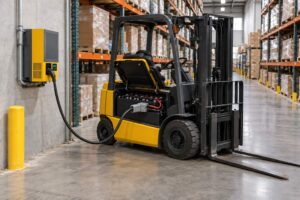
Ask three questions about the area, because the answers decide which provisions apply. Do batteries stay in the trucks? Do employees perform any maintenance there? Is electrolyte present in the area? OSHA’s charging-station directive STD 01-11-004, dated October 30, 1978, states that areas where batteries are charged only, with no maintenance performed, batteries not removed from the trucks and no electrolyte present, are not subject to paragraph (g)(2). Those areas still have to comply with (g)(1), (8), (9), (10), (11) and (12), and personal protective equipment is still required where the work calls for it. Charging in the truck alone does not establish the exception. If employees water batteries at the charger, the area is used for maintenance, and the spill-control, fire-protection, charger-protection and ventilation provisions come back into scope. An area that does both is treated as a servicing area throughout, not as two zones.
What does an inspector look for under 1910.178(g)?
An inspector works through the paragraphs, so walk them yourself first. The table below maps the standard to the physical thing being looked for. Paragraph (g)(3) is reserved in the current standard, and paragraph (g)(2) is worth reading twice: it names four separate requirements in a single sentence, which is where most gaps hide. If you are designing the space rather than inspecting it, our guide to building a battery room that meets OSHA standards covers the build side, and our overview of forklift charging station requirements covers station layout.
| What to check | Paragraph |
|---|---|
| Charge only in designated areas; position the truck and apply the brake before charging or changing a battery | (g)(1), (g)(8) |
| Where (g)(2) applies: electrolyte spill flushing and neutralizing, fire protection, protection of chargers from truck damage, and ventilation for gassing batteries | (g)(2) |
| Provide a conveyor, overhead hoist or equivalent handling equipment; position and secure reinstalled batteries | (g)(4), (g)(5) |
| Provide a carboy tilter or siphon for handling electrolyte; when mixing, pour acid into water, never water into acid | (g)(6), (g)(7) |
| Vent caps functioning; battery or compartment covers open to dissipate heat during charging | (g)(9) |
| Prohibit smoking; prevent open flames, sparks and electric arcs; keep metal tools and objects away from uncovered battery tops | (g)(10) to (g)(12) |
Follow equipment-specific procedures rather than general habit. Do not open sealed battery cases, and do not treat acid mixing as part of routine watering. Posted signs and written procedures make the rules usable on the floor, and the review should name the personal protective equipment each task requires.
Does your battery charging area need an eyewash station?
It depends on exposure, not on whether the area qualifies for the charging-only exception. The governing question under 29 CFR 1910.151(c) is whether employees’ eyes or bodies may be exposed to injurious corrosive materials. OSHA’s directive STD 01-08-002, dated March 8, 1982, ties the necessary provisions to the circumstances and extent of that exposure in battery charging and maintenance areas. ANSI/ISEA Z358.1 is a consensus standard OSHA recognizes as guidance rather than a federal regulation. Its selection and installation guidance describes equipment reachable within about ten seconds, a sustained 15-minute flush, and tepid water between 60 and 100 degrees Fahrenheit. The often-quoted 55 feet is an approximate walking distance, not a substitute for evaluating real access. Check delivered water temperature in cold weather, activate plumbed units weekly, and keep the log. Personal rinse bottles supplement first aid; they do not replace sustained flushing.
How much ventilation does a battery charging room need?
Enough to keep hydrogen from accumulating, which the standard requires without naming a number. Lead-acid batteries release hydrogen during charging, and paragraph (g)(2) calls for adequate ventilation for dispersal of fumes from gassing batteries, but sets no airflow figure. OSHA’s powered industrial truck eTool addresses the hazard without one either. The figures come from fire and mechanical codes, which generally recognize two paths: a system designed to hold flammable gas concentration to a fixed fraction of its lower flammable limit during worst-case simultaneous charging, or a prescriptive airflow rate tied to the room’s floor area. Which code edition your jurisdiction has adopted, and which path applies, is a question for your authority having jurisdiction. For larger fleets the caveat matters: the floor-area rate takes no account of how many batteries are charging or at what rate, so a large bank at equalize can calculate out above it.
If you have added batteries, changed chargers or increased simultaneous charging, have a qualified professional evaluate the installation before you price an exhaust upgrade.
What goes in the year-end budget request?
Three lines per item, written so an approver who has never seen the charging area can sign it. Maryland’s posted penalties give that approver context: MOSH lists maximums of $16,550 per violation, $16,550 per day for failure to abate, and $165,514 per willful or repeated violation, effective July 15, 2025, with a willful minimum of $16,550 against $11,823 federally. Actual penalties depend on the violation and the applicable assessment rules. Structure each request as:
- The condition: what was found, which task it affects, and the requirement or assessment behind it
- The action: immediate correction, equipment repair, or specialist evaluation
- The implementation: responsible person, completion date, and estimated cost including installation and downtime
Correct immediate hazards now rather than waiting for the budget cycle. If your fiscal year closes in December, gather quotes this month, and pair this review with a 30-day forklift fleet battery readiness audit so the safety findings and the maintenance findings reach the approver together.
Need help with battery equipment or maintenance?
Beal Industrial Products in Hanover has served industrial battery customers since 1980. We supply battery safety and maintenance products and provide industrial battery maintenance and repair across Maryland and the Mid-Atlantic. Tell us your battery types, fleet size, charging routine and what your safety team flagged. Call 410-768-6200 or contact Beal.
Frequently Asked Questions
Does the renewed OSHA warehouse emphasis program apply to Maryland warehouses?
Not directly. Maryland operates its own state plan through MOSH, which oversees most private-sector workplaces in the state. MOSH's published instruction index still lists its January 2024 warehousing instruction and no listed replacement for the 2026 federal renewal. Your obligations under 29 CFR 1910.178(g) apply regardless of inspection targeting.
Does a charging-only area need an eyewash station?
It depends on whether employees may be exposed to injurious corrosive materials, which is a separate question from the charging-only exception under STD 01-11-004. Assess the actual exposure and work activities in the area. An area where batteries are serviced, watered or have caps removed carries clear electrolyte exposure.
How many cubic feet per minute of ventilation does a battery room need?
The OSHA standard sets no airflow figure. Fire and mechanical codes supply the numbers, generally through either a design limiting flammable gas concentration to a fraction of its lower flammable limit, or a prescriptive rate tied to floor area. The applicable code edition and path are questions for your authority having jurisdiction.
What does paragraph 1910.178(g)(2) actually require?
Four things in one sentence: facilities for flushing and neutralizing spilled electrolyte, fire protection, protection of charging apparatus from damage by trucks, and adequate ventilation for dispersal of fumes from gassing batteries. Areas qualifying for the charging-only exception are not subject to (g)(2) but remain subject to six other paragraphs.

No comment yet, add your voice below!