


Real 2026 ranges for lead-acid, TPPL and lithium, the five variables that move a quote, and an RFQ spec that makes every quote comparable.
The short answer
A replacement lead-acid forklift battery runs roughly $3,500 to $5,000 for a common 48V unit, and $5,000 to $12,000 across the full size range. Lithium (LFP) for the same 48V truck runs roughly $8,000 to $20,000 and up.
The gap is not constant. At 48V and 1000Ah, common in three-shift distribution work, it narrows sharply: about $12,000 for lead-acid against $14,000 to $15,000 for LFP lithium. Below is what moves a quote inside those bands, how the three chemistries compare, and how to write a spec so your quotes line up.
In a hurry? Jump to the forklift battery RFQ spec block — copy it, send it to every vendor, and your quotes will be comparable.
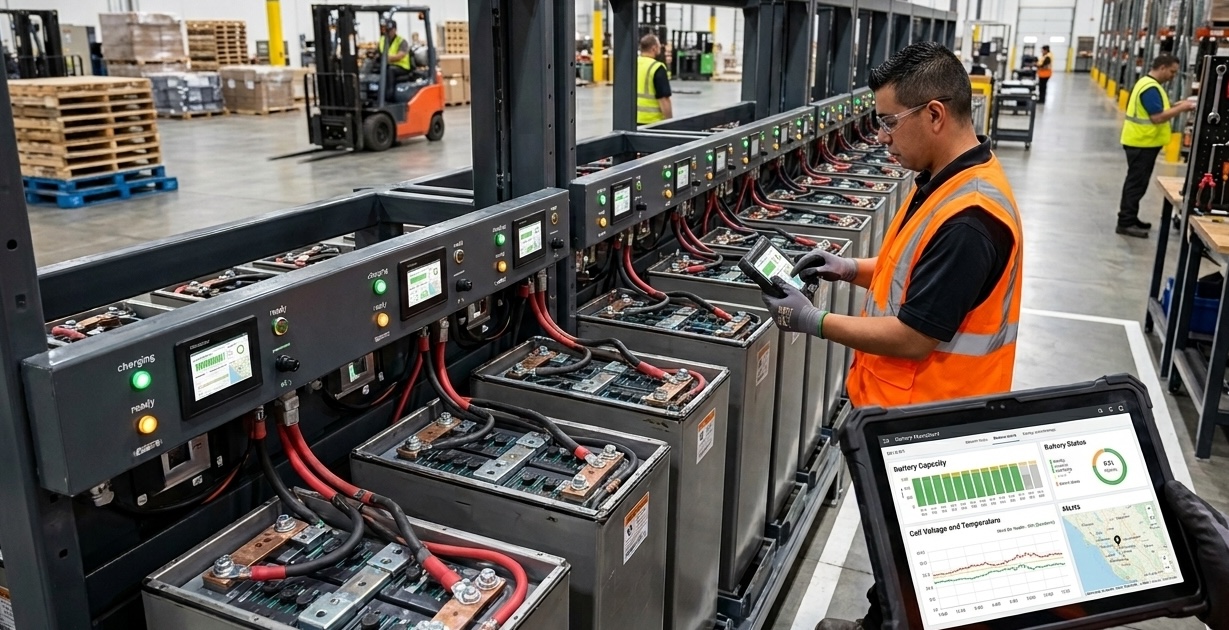
The three chemistries at a glance
How flooded lead-acid, TPPL and LFP lithium compare on the numbers that drive a 48V quote:
-
Flooded lead-acid — Price: ~$3,500–$5,000 (48V, common size). Charge: full charge plus cooldown; needs watering. Service life: ~5 years. Charge efficiency: ~75%. Best fit: single-shift work, budget-led buys, trucks that need the ballast weight.
-
TPPL (thin plate pure lead) — Price: roughly half of comparable lithium. Charge: partial opportunity charges, maintenance-free, no watering. Service life: shorter than flooded in hard use. Charge efficiency: high, between flooded and lithium. Best fit: two-shift work with opportunity-charging windows; retiring a watering program without an electrical rebuild.
-
LFP lithium — Price: ~$8,000–$20,000 and up (48V). Charge: fast, opportunity-charge friendly, maintenance-free. Service life: longest cycle life of the three. Charge efficiency: ~99%. Best fit: hard three-shift work where cycle life earns the premium and energy efficiency matters most.
These are general 2026 ranges. Voltage, Ah capacity, tray size, ballast and charger requirements can materially change the final quote. Efficiency and service-life figures are typical values; confirm against manufacturer specs for the exact battery quoted.
The five variables that set your price
Two batteries described the same way on a purchase order can differ by thousands of dollars. Five things account for most of it:
-
Voltage. 24V, 36V, 48V and 80V are the common steps. Price climbs with each one.
-
Amp-hour capacity. The biggest driver inside a given voltage. Always state Ah at the 6-hour rate so you are comparing like for like.
-
Tray dimensions. The battery has to fit the compartment exactly. A non-standard tray means a custom build and a longer lead time.
-
Connector type and cable. SB175, SB350 and the rest, plus cable length and exit position. Wrong connector, wrong quote.
-
Whether you need the weight. The one buyers forget. On a counterbalanced truck the battery is structural ballast, and a lithium pack of the same capacity weighs far less, so it may need added ballast to keep the truck’s rated capacity legal. That cost belongs in the comparison.
Purchase price versus total cost of ownership
As a rough budgeting rule, a replacement battery can represent a substantial share of the cost of an electric forklift — a useful sanity check. If a mid-size 48V quote lands well outside what you expected, something in the spec differs from what you asked for.
You have probably seen the vendor five-year comparison: roughly $30,000 to $50,000 for lead-acid against $18,000 to $26,000 for lithium. Check the footer. Almost all those tables are published by lithium vendors, and almost all are built on cell prices that no longer hold. We covered the same ground in our lead-acid versus lithium total cost of ownership breakdown, and four line items still get left out.
-
The charger delta. A lithium conversion typically requires a compatible lithium charger. Your lead-acid chargers generally do not carry over.
-
The electrical service. Fast charging at scale can mean new circuits, panel capacity, sometimes a service upgrade. Get an electrician’s number before you sign.
-
The stranded battery room. Convert a full fleet and the ventilated room, wash station and changing equipment become space you paid for and no longer use. An asset write-off, not a saving.
-
Energy cost, and here the numbers are regional. The figures below are Maryland/PJM-specific — if you operate elsewhere, check your own utility, though the direction is broadly national. PJM’s 2026/2027 capacity auction cleared at the $329.17 per MW-day cap, up about 22% year over year, with the BGE zone capped at $466.35, and bill increases of 1.5% to 5% were projected from June 2026. Charging efficiency therefore carries more weight than it did two years ago, and here lithium wins clearly: roughly 99% efficiency against roughly 75% for flooded lead-acid. That is the strongest honest argument for lithium, and rising Maryland power costs make it stronger.
The option most quotes skip: TPPL
Thin plate pure lead sits between the two and rarely appears in a quote unless you ask. TPPL is maintenance-free with no watering, and it takes fast opportunity charges well — EnerSys rates its NexSys TPPL line for high-rate charging that recovers a working charge in a fraction of a conventional cycle — typically costing around half of comparable lithium, with a shorter service life than flooded in hard use.
It fits two-shift operations with opportunity charging windows, fleets that want to retire the watering program without rebuilding the electrical service, and anyone whose lithium payback only worked at 2024 cell prices. It is wrong for hard three-shift work, where lithium’s cycle life earns the premium.
New, reconditioned, or rental
New makes sense when the truck has years of service left and the duty cycle is stable. Reconditioned suits spares, seasonal peaks and trucks nearing end of lease. Rental is the pragmatic answer more often this year, with lead times extended and rental demand strengthening. If a battery fails in November and your capital budget does not open until January, a rental bridges the gap.
2026 market conditions moving your quote
For most of the last decade, lithium quotes fell every year and lead-acid drifted up. In 2026 that flipped — worth knowing before you build a 2027 budget line.
Lithium pricing has become less predictable this year as LFP demand from grid and data-center energy storage competes for the same cells and materials your forklift battery uses. Global storage cell shipments rose roughly 120% year over year in Q1 2026, high-compaction LFP is effectively sold out, and cathode material rose sharply — and that procurement is not price sensitive the way a warehouse capex budget is. A sulfuric acid squeeze tied to the Strait of Hormuz has added pressure on lithium processing, where acid is consumed in tonnes per tonne of finished product. (Supply picture as of September 8, 2026; the Hormuz situation is fluid and figures may shift.)
Lead did the opposite. Lead metal has traded rangebound near $2,000 per tonne, with a projected 2026 global refined lead surplus. The acid squeeze touches lead-acid too, but electrolyte is a small share of a finished battery’s cost and North American producers buy acid domestically, so the exposure is not comparable. The full supply-chain analysis — spodumene processing, seaborne sulfur, Chinese export restrictions — is in our cost of ownership breakdown.
We sell both chemistries. This changes which quote is defensible in a budget meeting — it is not a preference for one line over the other.
How to request an accurate quote
The RFQ spec block
Most quote confusion comes from an incomplete spec. Send this block to every vendor and the numbers will line up. For the wider process, see Purchasing Batteries for Material Handling Equipment.
FORKLIFT BATTERY RFQ SPEC
1.  Truck make, model, serial number
2.  Voltage required
3.  Amp-hour capacity, stated at the 6-hour rate
4.  Tray dimensions: length x width x height, plus max weight
5.  Minimum battery weight required for ballast (from the truck data plate)
6.  Connector type and gender (e.g. SB175 gray)
7.  Cable length and exit position
8.  Chemistry quoted: flooded lead-acid / TPPL / LFP lithium
9.  Charger included? Voltage, amperage, input service required
10. Warranty: term, pro-rated or full replacement, what voids it
11. Installation, delivery and old battery removal included?
12. Service coverage: response time, on-site or depot, watering program
13. Lead time, in writing
14. Core credit / recycling value for the outgoing battery
One note on that last line. Lead batteries are the most recycled consumer product in the United States at roughly 99%, and most of the lead used by US battery makers comes from North American recycling. Your old battery has real value, more so in a tight supply year. Ask for the number.
Send us your spec, or send us your competitor’s quote
Beal has supplied industrial batteries and chargers across Maryland, Northern Virginia, Delaware and South-Central Pennsylvania since 1980. We are independent of any forklift OEM, so we quote every chemistry and tell you which one your duty cycle justifies, including the one that costs us less to sell you. Send your spec, or the quote you already have, and we will price against it line by line.
Forklift batteries · Battery rental and leasing
Sources
-
PJM Interconnection — 2026/2027 Base Residual Auction Report (July 2025): capacity cleared at the $329.17/MW-day cap, up ~22% YoY, BGE zone capped at $466.35. pjm.com
-
Maryland Matters — “Energy bills likely to tick up again in 2026” (July 2025): projected 1.5–5% residential bill increases from June 2026. marylandmatters.org
-
ILZSG (October 2025): forecast ~102,000-tonne global refined lead surplus for 2026. ilzsg.org
-
Yicai Global — “Top Chinese LFP Battery Material Suppliers Want to Hike Prices in 2026” (December 2025): RMB 1,000–2,000/tonne cathode adjustment. yicaiglobal.com
-
EnergyTrend (May 2026): Q1 2026 global storage cell shipments up ~120% YoY on AI data-center demand. energytrend.com
-
Heatmap News (2026) — “The Hormuz Closure Is Driving a Shortage of Battery Ingredients”: 2026 sulfur supply gap of 5.13M tonnes. heatmap.news
-
U.S. Department of Energy / industry material-handling data — charge efficiency for flooded lead-acid (~75%) versus LFP lithium (~99%) in industrial battery applications. Confirm against the manufacturer spec for the exact battery quoted.
-
EnerSys — NexSys TPPL product page and datasheet: thin plate pure lead chemistry rated for high-rate opportunity charging, maintenance-free with no watering. enersys.com
Frequently Asked Questions
How much does a forklift battery cost?
In 2026, a replacement lead-acid forklift battery runs roughly $3,500 to $5,000 for a common 48V unit, and $5,000 to $12,000 across the full size range. Lithium (LFP) for the same 48V truck runs roughly $8,000 to $20,000 and up. The gap narrows sharply at high capacity: at 48V and 1000Ah it's about $12,000 for lead-acid against $14,000 to $15,000 for lithium.
Why did forklift battery prices move in different directions in 2026?
For most of the last decade lithium prices fell while lead-acid drifted up, but in 2026 that flipped. LFP cathode material rose sharply as AI data center storage demand bid for the same cells, high-compaction LFP effectively sold out, and a sulfuric acid shortage tied to the Strait of Hormuz squeezed lithium processing. Lead stayed rangebound near $2,000 per tonne with a projected 2026 refined lead surplus, so lead-acid pricing held far steadier.
What are the five variables that determine a forklift battery quote?
Five things account for most of the price difference between two batteries described the same way: voltage (24V, 36V, 48V, 80V), amp-hour capacity stated at the 6-hour rate, tray dimensions that must fit the compartment exactly, connector type and cable, and the minimum battery weight required for ballast on counterbalanced trucks. State all five in your RFQ and your quotes will line up.

No comment yet, add your voice below!